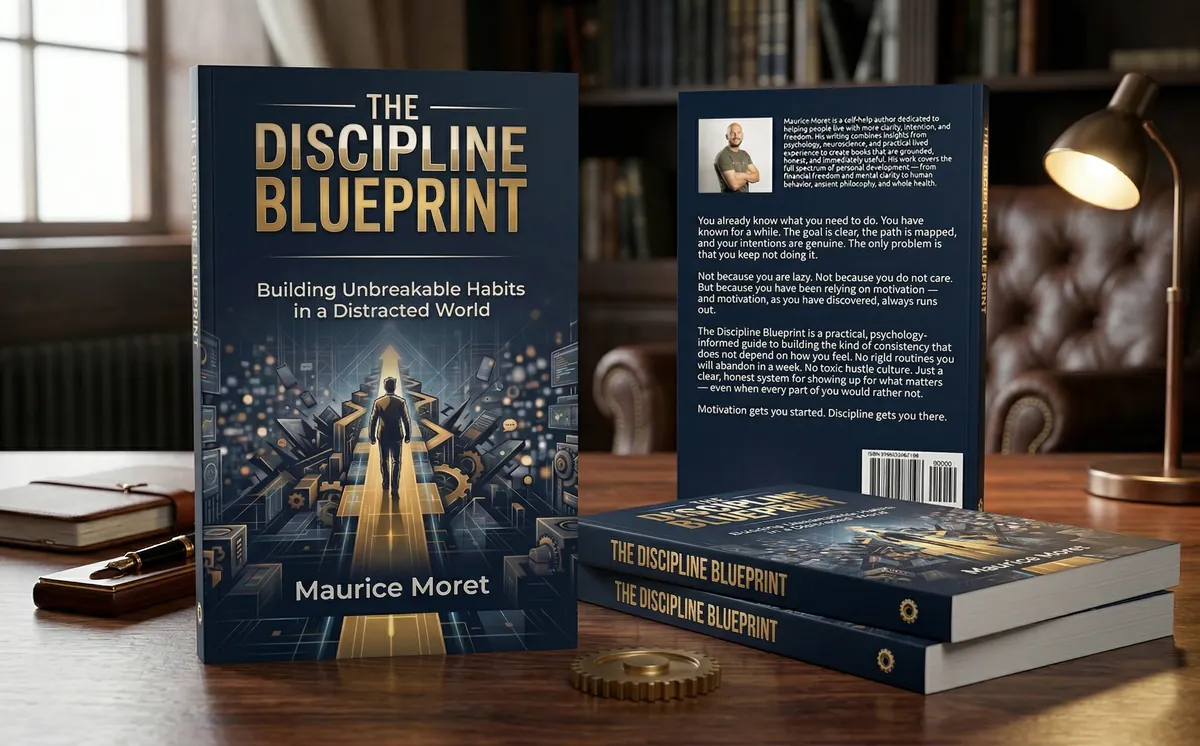
Every January, millions of people set goals. By February, most have quietly abandoned them. This is not a mystery, and it is not because those people are lazy or weak. It is because they built their plans on the wrong foundation. They relied on motivation — a resource that is, by its nature, temporary.
Motivation is an emotion. It spikes when you watch an inspiring video, when you have a breakthrough insight, or when you start something new and the novelty is high. Then it fades. It always fades. Not because something is wrong with you, but because that is how emotions work. They are designed to fluctuate. Building your entire approach to change on an emotion that fluctuates is like building a house on a foundation that shifts with the weather.
Discipline is different. Discipline is a system. And systems, when designed well, work regardless of how you feel on any given day.
The Habit Loop: Understanding the Machinery of Behavior
Every habit — good or bad — runs on the same three-part loop: cue, routine, reward. The cue is the trigger that initiates the behavior. The routine is the behavior itself. The reward is what your brain gets out of it, which determines whether the loop gets reinforced.
When you grab your phone first thing in the morning, the cue might be waking up and feeling groggy. The routine is scrolling. The reward is a small hit of stimulation that makes the grogginess feel more bearable. That loop runs automatically because it has been reinforced thousands of times.
The key insight is that you do not break habits by fighting the loop. You break them by redesigning it. Keep the cue, change the routine, maintain a reward. If the cue is waking up groggy, the new routine could be drinking a glass of water and doing five minutes of stretching. The reward — feeling more alert — is actually better than what scrolling provided. But you have to design this intentionally. Left to its own devices, your brain will always default to the path of least resistance.
Identity-Based Habits: Becoming vs. Doing
Most people frame their goals around outcomes. "I want to lose twenty pounds." "I want to write a book." "I want to run a marathon." These are fine as destinations, but they create a problem: until you reach the outcome, you feel like you are failing. And if the outcome takes months or years, that is a long time to feel like you are not there yet.
A more effective approach is identity-based habits. Instead of "I want to lose weight," the frame becomes "I am someone who moves their body every day." Instead of "I want to write a book," it becomes "I am a writer — writers write daily." The shift is from doing to becoming. Every small action becomes evidence for the new identity, and each piece of evidence strengthens your belief in it.
This is not positive affirmation or wishful thinking. It is a feedback loop grounded in behavior. You act, the action provides evidence, the evidence shapes your self-image, and the updated self-image makes the next action easier. Research in behavioral psychology consistently shows that people who tie their habits to identity — rather than outcomes — maintain those habits at significantly higher rates over time.
The question to ask yourself is not "What do I want to achieve?" but "Who do I want to become?" Then reverse-engineer the daily actions that person would take.
Environment Design: The Strategy That Beats Willpower Every Time
Willpower is a limited resource. Study after study confirms this. The people who appear to have extraordinary self-control are not resisting temptation better than everyone else — they are encountering less temptation. They have designed their environments to make good choices easy and bad choices hard.
This is the concept of friction. Every behavior has a friction cost — the number of steps, the amount of effort, the time delay between the impulse and the action. Want to eat healthier? Put the fruit on the counter and the chips in a high cabinet. Want to go to the gym in the morning? Sleep in your workout clothes and put your shoes by the door. Want to read before bed instead of scrolling? Put a book on your pillow and charge your phone in another room.
These changes feel almost too simple to work. That is precisely why they do. You are not relying on a decision in the moment, when your willpower is depleted and your brain is looking for the easiest option. You are making the decision once, in advance, and then letting the environment carry it forward.
The inverse applies to habits you want to eliminate. Add friction. Make it harder to do the thing. Unsubscribe from the delivery app. Log out of social media after each session. Remove the shortcut from your home screen. Each additional step gives your rational brain a chance to intervene before autopilot takes over.
The Compound Effect: Why Small Actions Create Massive Results
People overestimate what they can accomplish in a week and underestimate what they can accomplish in a year. This is the compound effect, and it is the most underappreciated force in personal development.
Consider this: if you improve by just one percent each day, you will be thirty-seven times better after one year. That is not motivational math — it is actual exponential growth. The problem is that one percent does not feel like anything on any given day. You read for twenty minutes and you are not smarter. You exercise for thirty minutes and you do not look different. You write five hundred words and you do not have a book. The results are invisible in the short term, which is why most people quit.
But the people who do not quit — the ones who stack small actions day after day, week after week — eventually hit a tipping point where the results become undeniable. The author who writes five hundred words a day has a complete manuscript in six months. The person who walks thirty minutes daily has logged over a hundred hours of movement by year's end. The person who saves a small amount each paycheck builds wealth that surprises even them.
"We are what we repeatedly do. Excellence, then, is not an act, but a habit." — Will Durant, summarizing Aristotle
The compound effect rewards consistency over intensity. Five moderate workouts per week outperform two extreme sessions. Thirty minutes of daily practice outperforms a six-hour weekend binge. Showing up matters more than showing off.
Build the System, Then Trust It
Here is the practical takeaway. Stop waiting to feel motivated. Instead, build the architecture of a disciplined life:
- Choose one keystone habit — a single behavior that, if done consistently, creates positive ripple effects across other areas of your life.
- Design your environment to support that habit. Reduce friction for the behavior you want. Increase friction for the behavior you do not.
- Tie the habit to your identity. You are not someone trying to exercise. You are an athlete in training. You are not someone trying to read more. You are a reader.
- Set non-negotiables. Identify the two or three daily actions that are not up for debate. They happen regardless of mood, weather, or schedule. Non-negotiables remove the decision from the equation — and it is the decision that drains willpower, not the action itself.
- Use time blocking. Assign specific time windows to your most important work. An open calendar invites distraction. A blocked calendar protects your priorities.
- Track your consistency, not your results. Put an X on a calendar every day you show up. Your only goal is to not break the chain. Results will follow.
Discipline is not punishment. It is not about forcing yourself to do things you hate through sheer grit. It is about building a structure that carries you forward on the days when you do not feel like moving. It is about trusting the process enough to keep showing up, even when the progress is invisible. Because it is there. Compounding silently. Waiting for the moment it becomes impossible to ignore.
