
We live in a culture that equates health with how you look. Flat stomach, visible muscles, low body fat percentage — if you have those, you must be healthy. And if you do not, you must be failing. But anyone who has ever been physically fit while mentally falling apart knows that this equation is broken. You can run a marathon and still feel empty. You can eat clean and still feel anxious every day. You can look healthy and be anything but.
That is because health is not one thing. It is at least six things, and they are all connected. When we focus obsessively on one dimension while ignoring the others, we do not get healthy — we get imbalanced. And imbalance, eventually, breaks down even the areas we thought we had under control.
The Six Dimensions of Wellness
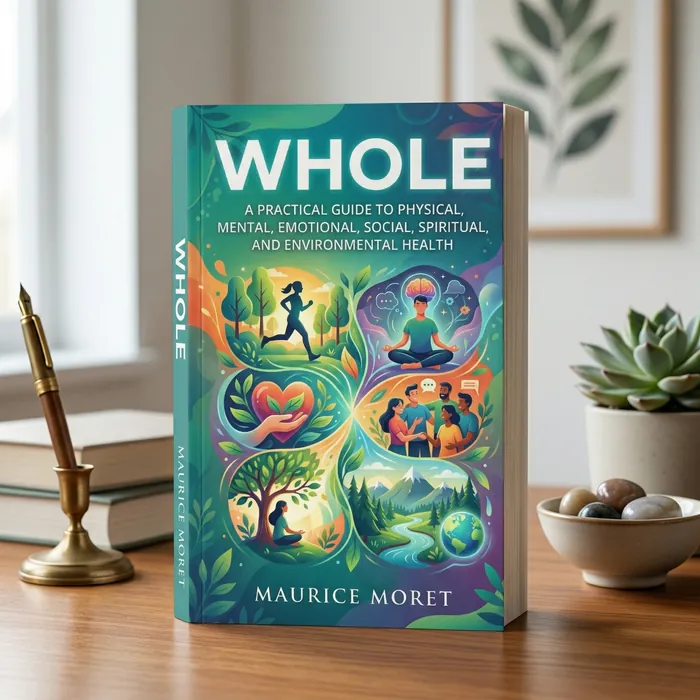
Think of your overall well-being as a structure held up by six pillars. If one is weak, the whole thing is unstable. If several are crumbling, it does not matter how strong the remaining ones are — the structure will not hold.
Physical health is the dimension most people think of first. It covers movement, nutrition, sleep, and the basic functioning of your body. It matters enormously, but it is not the whole picture. A person who exercises daily but sleeps four hours a night is not physically healthy. A person who eats perfectly but never moves is not either. Even within this single dimension, balance is required.
Mental health involves how you think — your cognitive patterns, your ability to focus, your relationship with stress, and the narratives you tell yourself about who you are and what you are capable of. Chronic overthinking, negative self-talk, and unmanaged stress live here. You can be physically strong and mentally exhausted at the same time, and the mental exhaustion will eventually erode the physical strength.
Emotional health is about how you process and express feelings. It is not the same as mental health, though they overlap. You can think clearly and still be unable to sit with sadness, express anger in a healthy way, or accept joy without guilt. Emotional health means being able to feel the full range of human emotions without being controlled by them or numbing them out.
Social health covers your relationships and sense of connection. Humans are not designed for isolation. Study after study shows that the quality of your relationships is one of the strongest predictors of both happiness and longevity — stronger than diet, exercise, or income. Yet many people invest hours in the gym and zero minutes in maintaining meaningful friendships.
Spiritual health does not necessarily mean religion, though it can. It means having a sense of purpose, meaning, and connection to something larger than yourself. It means knowing why you get up in the morning beyond just paying bills. People without this dimension often describe a feeling of emptiness that no amount of achievement or physical comfort can fill.
Environmental health is the most overlooked dimension. It refers to how your surroundings affect your well-being — the physical spaces where you live and work, the air you breathe, the noise levels around you, the order or chaos of your immediate environment. A cluttered, noisy, or toxic environment drains energy in ways that are constant but invisible until you change them.
Why Neglecting One Area Undermines the Others
These dimensions are not independent compartments. They are deeply interconnected, and weakness in one area creates a cascading effect across the others.
Consider someone who is physically active but socially isolated. The lack of connection creates chronic low-level stress, which disrupts sleep, which undermines physical recovery, which makes training harder, which leads to frustration and negative self-talk — a mental health problem that started as a social one.
Or consider someone who has strong relationships and a clear sense of purpose but lives in a chaotic, cluttered environment. The constant sensory noise and disorganization drain cognitive resources, making it harder to focus, harder to regulate emotions, and harder to follow through on the physical health habits they know they should maintain.
You cannot compartmentalize wellness. Your mind affects your body. Your relationships affect your mind. Your environment affects everything. Lasting health requires attention to the whole system, not just the parts that are visible.
This interconnection is actually good news. It means that improving any one dimension often creates positive ripple effects in the others. Start exercising and your mood improves. Improve your mood and your relationships get easier. Strengthen your relationships and your sense of purpose deepens. Deepen your purpose and you find more motivation to take care of your body. The cycle works in both directions — and you get to choose which direction you feed.
A Practical Approach to Whole-Person Wellness
You do not need to overhaul all six dimensions at once. That is a recipe for overwhelm and burnout. Instead, start by honestly assessing where you stand in each area and identifying the one or two that are most neglected. Those are your highest-leverage starting points.
Here are practical ways to nurture each dimension:
- Physical: Move your body daily in a way you actually enjoy. Prioritize sleep above everything else — it is the foundation that supports all other dimensions. Eat mostly whole foods without making nutrition a source of anxiety.
- Mental: Build a practice of noticing your thoughts without believing all of them. Journaling, meditation, or even a daily five-minute quiet reflection can interrupt destructive thought patterns. Reduce information overload by limiting news and social media consumption.
- Emotional: Give yourself permission to feel without immediately trying to fix or suppress. Name your emotions — research shows that simply labeling a feeling reduces its intensity. Talk to someone you trust about what you are going through rather than processing everything alone.
- Social: Invest in a small number of deep relationships rather than a large number of shallow ones. Initiate contact — do not wait for others to reach out. Show up for people consistently, and let people show up for you.
- Spiritual: Spend time in nature. Reflect on what gives your life meaning beyond material success. Volunteer, create something, or engage with a community that shares your values. Purpose does not have to be grand — it just has to be real.
- Environmental: Declutter your living and working spaces. Reduce noise. Let in natural light. Surround yourself with things that support calm and focus rather than distraction and stress. Your environment is either working for you or against you — there is no neutral.
Start Where You Are
The point is not perfection across all six dimensions. That does not exist. The point is awareness — knowing which areas are strong, which are neglected, and what small step you can take today to bring the weakest one up even slightly.
Most people spend their entire lives pouring energy into one or two dimensions while wondering why they still feel incomplete. They work out harder, earn more money, or chase the next achievement, hoping it will finally be enough. It never is, because the problem is not intensity — it is scope.
Real health is not about being the fittest person in the room. It is about being a whole person — someone who can move well, think clearly, feel deeply, connect honestly, live purposefully, and exist in an environment that supports all of it. That is not a destination. It is a daily practice of paying attention to the parts of yourself that tend to get ignored.
You do not need to have it all figured out. You just need to stop pretending that one dimension is the whole story.
